/** * ThreadLocalMap is a customized hash map suitable only for * maintaining thread local values. No operations are exported * outside of the ThreadLocal class. The class is package private to * allow declaration of fields in class Thread. To help deal with * very large and long-lived usages, the hash table entries use * WeakReferences for keys. However, since reference queues are not * used, stale entries are guaranteed to be removed only when * the table starts running out of space. */ static class ThreadLocalMap{}
从注释可以看出作者为什么使用弱引用,为了处理大对象和长周期对象,在GC时可以主动回收
一直感觉这儿的弱引用设计是个鸡肋
在实际使用中,还是会出现内存泄漏,何必使用弱引用呢?
在ThreadLocal的类注释中
1 2 3 4 5 6
This class provides thread-local variables. These variables differ from * their normal counterparts in that each thread that accesses one (via its * {@code get} or {@code set} method) has its own, independently initialized * copy of the variable. {@code ThreadLocal} instances are typically private * static fields in classes that wish to associate state with a thread (e.g., * a user ID or Transaction ID).
Because if it were an instance level field, then it would actually be “Per Thread - Per Instance”, not just a guaranteed “Per Thread.” That isn’t normally the semantic you’re looking for.
Usually it’s holding something like objects that are scoped to a User Conversation, Web Request, etc. You don’t want them also sub-scoped to the instance of the class. One web request => one Persistence session. Not one web request => one persistence session per object.
tab[i] = new Entry(key, value); int sz = ++size; if (!cleanSomeSlots(i, sz) && sz >= threshold) rehash();
再看rehash();
1 2 3 4 5 6 7 8 9 10 11 12
/**
 * Re-pack and/or re-size the table. First scan the entire
 * table removing stale entries. If this doesn't sufficiently
 * shrink the size of the table, double the table size.
 */
private void rehash() {
    expungeStaleEntries();

    // Use lower threshold for doubling to avoid hysteresis
    if (size >= threshold - threshold / 4)
        resize();
}
/**
 * ThreadLocals rely on per-thread linear-probe hash maps attached
 * to each thread (Thread.threadLocals and
 * inheritableThreadLocals).  The ThreadLocal objects act as keys,
 * searched via threadLocalHashCode.  This is a custom hash code
 * (useful only within ThreadLocalMaps) that eliminates collisions
 * in the common case where consecutively constructed ThreadLocals
 * are used by the same threads, while remaining well-behaved in
 * less common cases.
 */
private final int threadLocalHashCode = nextHashCode();

/**
 * The next hash code to be given out. Updated atomically. Starts at
 * zero.
 */
private static AtomicInteger nextHashCode =
    new AtomicInteger();

/**
 * The difference between successively generated hash codes - turns
 * implicit sequential thread-local IDs into near-optimally spread
 * multiplicative hash values for power-of-two-sized tables.
 */
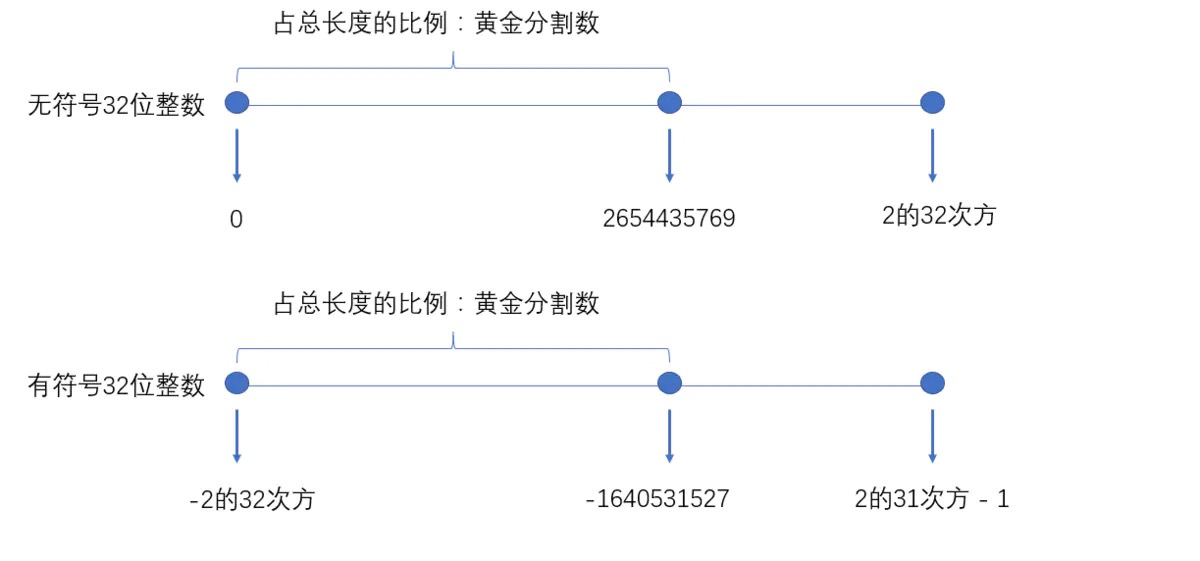
private static final int HASH_INCREMENT = 0x61c88647;

/**
 * Returns the next hash code.
 */
private static int nextHashCode() {
    return nextHashCode.getAndAdd(HASH_INCREMENT);
}