sar(System Activity Reporter系统活动情况报告)是目前 Linux 上最为全面的系统性能分析工具之一,可以从多方面对系统的活动进行报告,包括:文件的读写情况、系统调用的使用情况、磁盘I/O、CPU效率、内存使用状况、进程活动及IPC有关的活动等
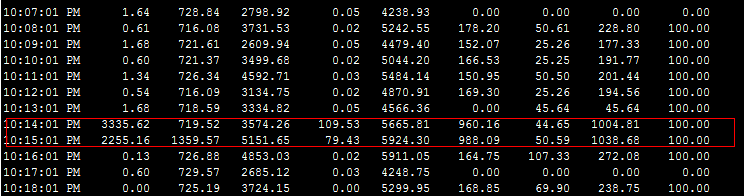
sar -B 输出说明:
输出项说明:
pgpgin/s:表示每秒从磁盘或SWAP置换到内存的字节数(KB)
pgpgout/s:表示每秒从内存置换到磁盘或SWAP的字节数(KB)
fault/s:每秒钟系统产生的缺页数,即主缺页与次缺页之和(major + minor)
majflt/s:每秒钟产生的主缺页数.
pgfree/s:每秒被放入空闲队列中的页个数
pgscank/s:每秒被kswapd扫描的页个数
pgscand/s:每秒直接被扫描的页个数
pgsteal/s:每秒钟从cache中被清除来满足内存需要的页个数
%vmeff:每秒清除的页(pgsteal)占总扫描页(pgscank+pgscand)的百分比
SWAP
可以看到大量的pgin,这儿就不得不再普及一下linux的swap
Linux divides its physical RAM (random access memory) into chucks of memory called pages. Swapping is the process whereby a page of memory is copied to the preconfigured space on the hard disk, called swap space, to free up that page of memory. The combined sizes of the physical memory and the swap space is the amount of virtual memory available.
Swap space in Linux is used when the amount of physical memory (RAM) is full. If the system needs more memory resources and the RAM is full, inactive pages in memory are moved to the swap space. While swap space can help machines with a small amount of RAM, it should not be considered a replacement for more RAM. Swap space is located on hard drives, which have a slower access time than physical memory.Swap space can be a dedicated swap partition (recommended), a swap file, or a combination of swap partitions and swap files.
A memory model describes, given a program and an execution trace of that program, whether the execution trace is a legal execution of the program. For the Java programming language, the memory model works by examining each read in an execution trace and checking that the write observed by that read is valid according to certain rules.
Writes and reads of volatile long and double values are always atomic. Writes to and reads of references are always atomic, regardless of whether they are implemented as 32-bit or 64-bit values.
class VolatileExample { int a = 0; volatile boolean flag = false; public void writer() { a = 1; //1 flag = true; //2 } public void reader() { if (flag) { //3 int i = a; //4 …… } } }
假设线程A执行writer()方法之后,线程B执行reader()方法。根据happens before规则,这个过程建立的happens before 关系可以分为两类: · 根据程序次序规则,1 happens before 2; 3 happens before 4。 · 根据volatile规则,2 happens before 3。 · 根据happens before 的传递性规则,1 happens before 4。 上述happens before 关系的图形化表现形式如下:
在上图中,每一个箭头链接的两个节点,代表了一个happens before 关系。黑色箭头表示程序顺序规则;橙色箭头表示volatile规则;蓝色箭头表示组合这些规则后提供的happens before保证。
Each object is associated with a monitor. A monitor is locked if and only if it has an owner. The thread that executes monitorenter attempts to gain ownership of the monitor associated with objectref, as follows: • If the entry count of the monitor associated with objectref is zero, the thread enters the monitor and sets its entry count to one. The thread is then the owner of the monitor. • If the thread already owns the monitor associated with objectref, it reenters the monitor, incrementing its entry count. • If another thread already owns the monitor associated with objectref, the thread blocks until the monitor’s entry count is zero, then tries again to gain ownership.
The thread that executes monitorexit must be the owner of the monitor associated with the instance referenced by objectref. The thread decrements the entry count of the monitor associated with objectref. If as a result the value of the entry count is zero, the thread exits the monitor and is no longer its owner. Other threads that are blocking to enter the monitor are allowed to attempt to do so.
class SynchronizedExample { int a = 0; boolean flag = false; public synchronized void writer() { a = 1; flag = true; } public synchronized void reader() { if (flag) { int i = a; …… } } }
CAS 操作包含三个操作数 —— 内存位置(V)、预期原值(A)和新值(B)。如果内存位置的值与预期原值相匹配,那么处理器会自动将该位置值更新为新值。否则,处理器不做任何操作。无论哪种情况,它都会在 CAS 指令之前返回该位置的值。 (在 CAS 的一些特殊情况下将仅返回 CAS 是否成功,而不提取当前值。) CAS 有效地说明了“我认为位置 V 应该包含值 A;如果包含该值,则将 B 放到这个位置; 否则,不要更改该位置,只告诉我这个位置现在的值即可。”这其实和乐观锁的冲突检查+数据更新的原理是一样的。
1
2
3
public final boolean compareAndSet(int expect, int update) { return unsafe.compareAndSwapInt(this, valueOffset, expect, update); }
// Adding a lock prefix to an instruction on MP machine // VC++ doesn't like the lock prefix to be on a single line // so we can't insert a label after the lock prefix. // By emitting a lock prefix, we can define a label after it. #define LOCK_IF_MP(mp) __asm cmp mp, 0 \ __asm je L0 \ __asm _emit 0xF0 \ __asm L0:
inline jint Atomic::cmpxchg (jint exchange_value, volatile jint* dest, jint compare_value) { // alternative for InterlockedCompareExchange int mp = os::is_MP(); __asm { mov edx, dest mov ecx, exchange_value mov eax, compare_value LOCK_IF_MP(mp) cmpxchg dword ptr [edx], ecx } }
循环时间长开销大。自旋CAS如果长时间不成功,会给CPU带来非常大的执行开销。如果JVM能支持处理器提供的pause指令那么效率会有一定的提升,pause指令有两个作用,第一它可以延迟流水线执行指令(de-pipeline),使CPU不会消耗过多的执行资源,延迟的时间取决于具体实现的版本,在一些处理器上延迟时间是零。第二它可以避免在退出循环的时候因内存顺序冲突(memory order violation)而引起CPU流水线被清空(CPU pipeline flush),从而提高CPU的执行效率。
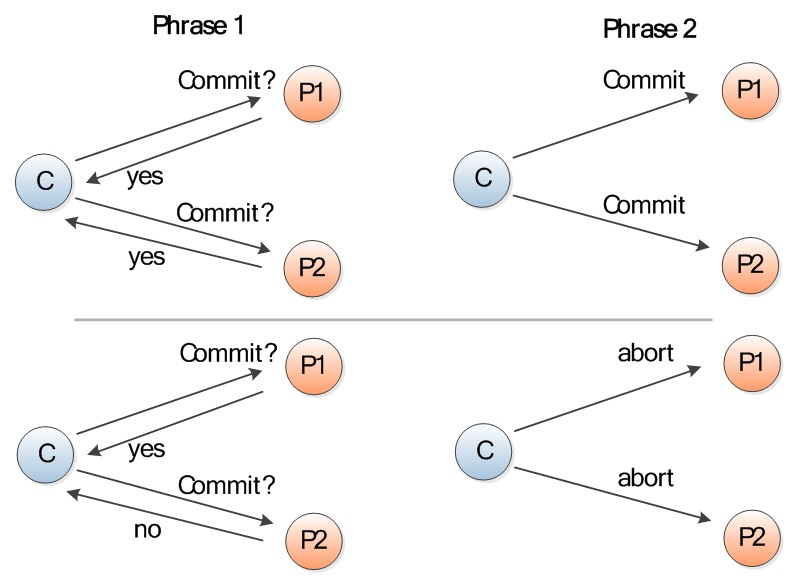
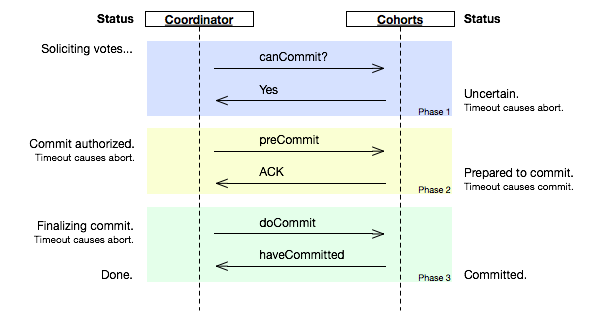
coordinator接收完participant的反馈(vote)之后,进入阶段2,给各个participant发送准备提交(prepare to commit)指令。participant接到准备提交指令后可以锁资源,但要求相关操作必须可回滚。coordinator接收完确认(ACK)后进入阶段3、进行commit/abort,3PC的阶段3与2PC的阶段2无异。协调者备份(coordinator watchdog)、状态记录(logging)同样应用在3PC。
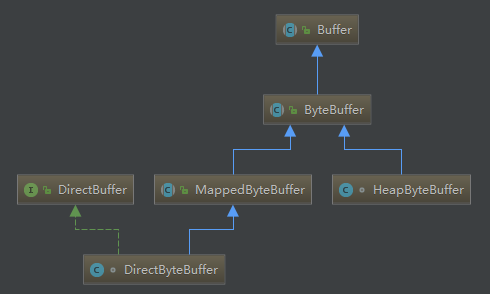
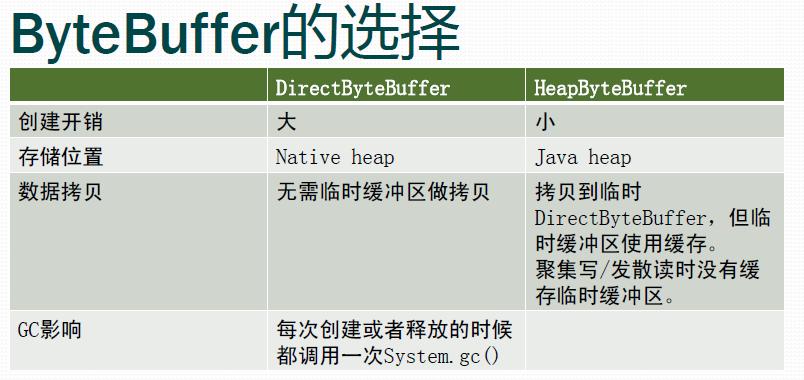
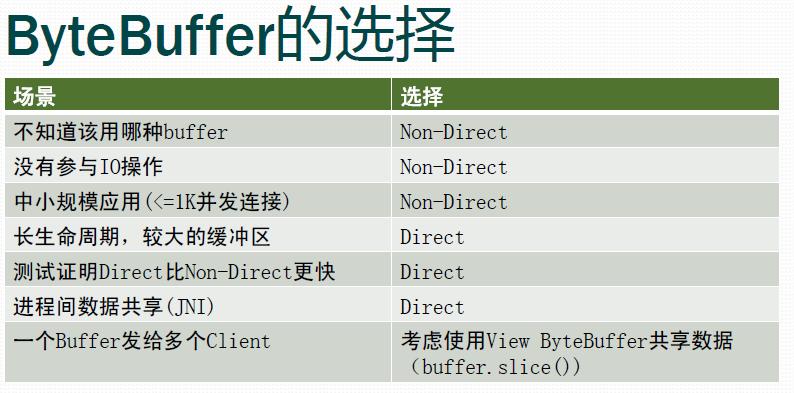
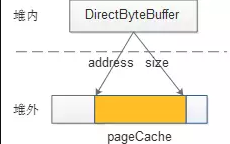
A byte buffer is either direct or non-direct. Given a direct byte buffer, the Java virtual machine will make a best effort to perform native I/O operations directly upon it. That is, it will attempt to avoid copying the buffer’s content to (or from) an intermediate buffer before (or after) each invocation of one of the underlying operating system’s native I/O operations. A direct byte buffer may be created by invoking the allocateDirect factory method of this class. The buffers returned by this method typically have somewhat higher allocation and deallocation costs than non-direct buffers. The contents of direct buffers may reside outside of the normal garbage-collected heap, and so their impact upon the memory footprint of an application might not be obvious. It is therefore recommended that direct buffers be allocated primarily for large, long-lived buffers that are subject to the underlying system’s native I/O operations. In general it is best to allocate direct buffers only when they yield a measureable gain in program performance. A direct byte buffer may also be created by mapping a region of a file directly into memory. An implementation of the Java platform may optionally support the creation of direct byte buffers from native code via JNI. If an instance of one of these kinds of buffers refers to an inaccessible region of memory then an attempt to access that region will not change the buffer’s content and will cause an unspecified exception to be thrown either at the time of the access or at some later time.
class HeapByteBuffer extends ByteBuffer { HeapByteBuffer(int cap, int lim) { // package-private
super(-1, 0, lim, cap, new byte[cap], 0); /* hb = new byte[cap]; offset = 0; */ } } public abstract class ByteBuffer extends Buffer implements Comparable<ByteBuffer> {
// These fields are declared here rather than in Heap-X-Buffer in order to // reduce the number of virtual method invocations needed to access these // values, which is especially costly when coding small buffers. // final byte[] hb; // Non-null only for heap buffers final int offset; boolean isReadOnly; // Valid only for heap buffers
// Creates a new buffer with the given mark, position, limit, capacity, // backing array, and array offset // ByteBuffer(int mark, int pos, int lim, int cap, // package-private byte[] hb, int offset) { super(mark, pos, lim, cap); this.hb = hb; this.offset = offset; }
static void reserveMemory(long size, int cap) { synchronized (Bits.class) { if (!memoryLimitSet && VM.isBooted()) { maxMemory = VM.maxDirectMemory(); memoryLimitSet = true; } // -XX:MaxDirectMemorySize limits the total capacity rather than the // actual memory usage, which will differ when buffers are page // aligned. if (cap <= maxMemory - totalCapacity) { reservedMemory += size; totalCapacity += cap; count++; return; } }
System.gc(); try { Thread.sleep(100); } catch (InterruptedException x) { // Restore interrupt status Thread.currentThread().interrupt(); } synchronized (Bits.class) { if (totalCapacity + cap > maxMemory) throw new OutOfMemoryError("Direct buffer memory"); reservedMemory += size; totalCapacity += cap; count++; } }
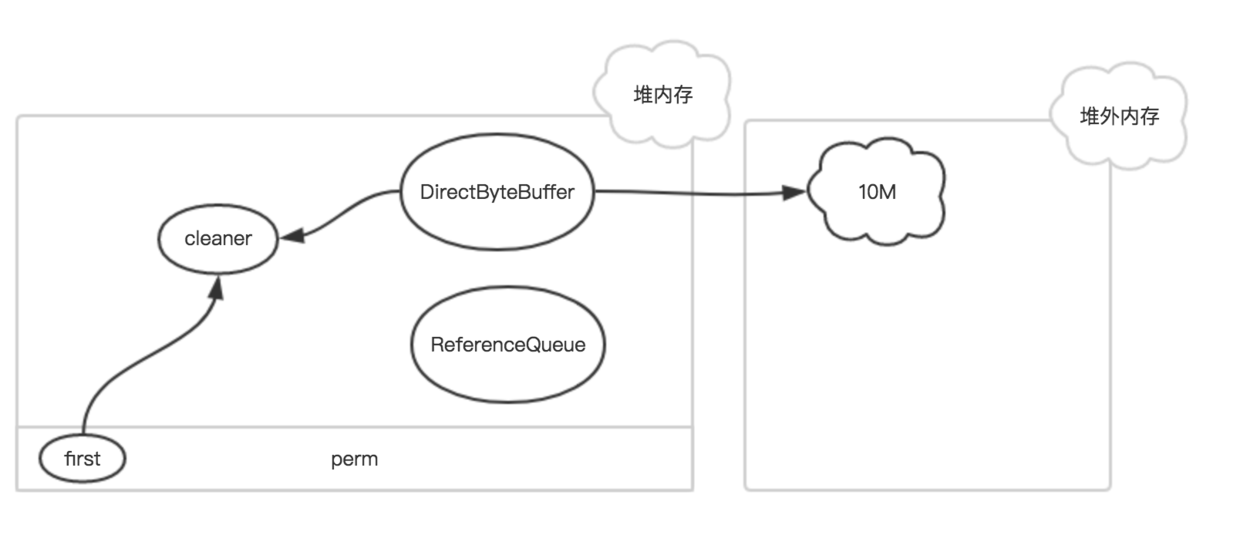
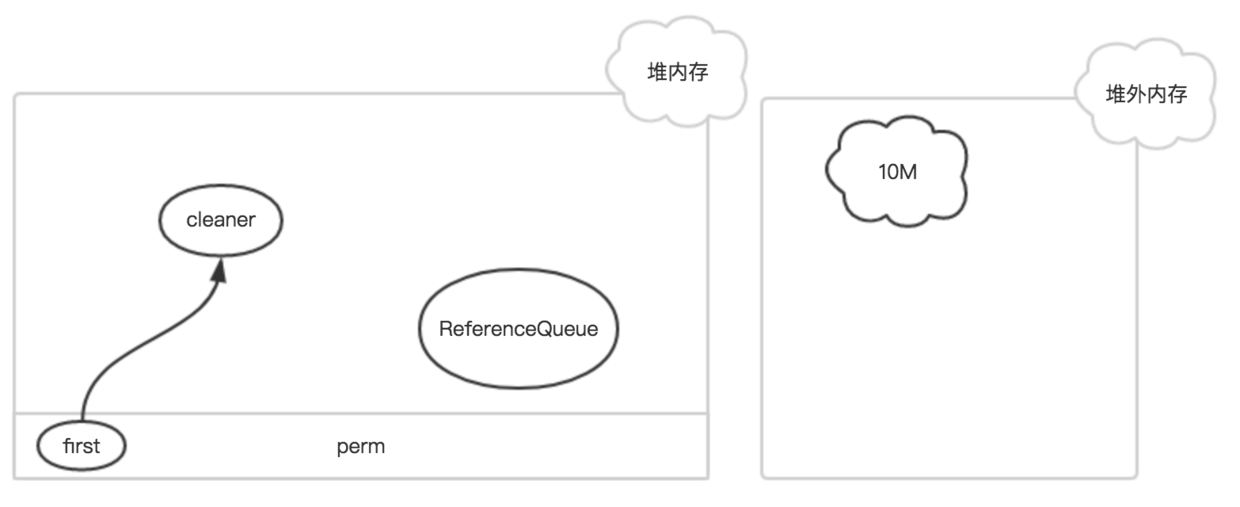
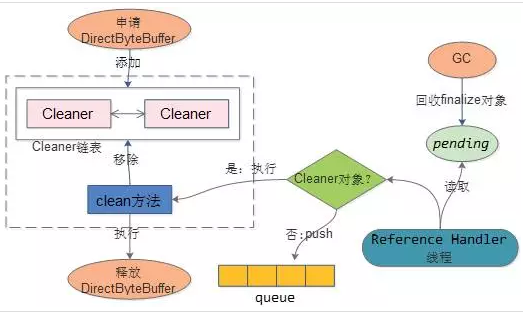
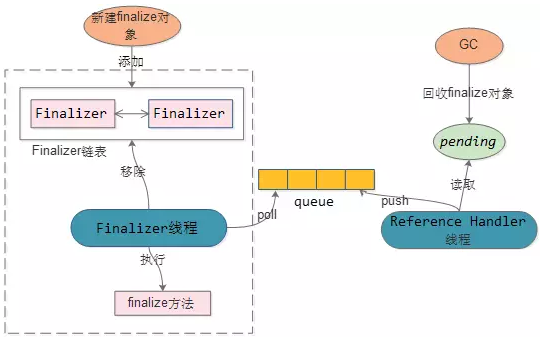
public class Cleaner extends PhantomReference<Object> { private static final ReferenceQueue<Object> dummyQueue = new ReferenceQueue(); private static Cleaner first = null; private Cleaner next = null; private Cleaner prev = null; private final Runnable thunk;
public void run() { for (;;) { Reference<Object> r; synchronized (lock) { if (pending != null) { r = pending; pending = r.discovered; r.discovered = null; } else { // The waiting on the lock may cause an OOME because it may try to allocate // exception objects, so also catch OOME here to avoid silent exit of the // reference handler thread. // // Explicitly define the order of the two exceptions we catch here // when waiting for the lock. // // We do not want to try to potentially load the InterruptedException class // (which would be done if this was its first use, and InterruptedException // were checked first) in this situation. // // This may lead to the VM not ever trying to load the InterruptedException // class again. try { try { lock.wait(); } catch (OutOfMemoryError x) { } } catch (InterruptedException x) { } continue; } }
// Fast path for cleaners if (r instanceof Cleaner) { ((Cleaner)r).clean(); continue; }
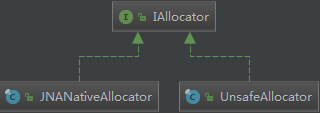
JNA provides Java programs easy access to native shared libraries without writing anything but Java code - no JNI or native code is required
堆外缓存OHC便是使用JNA来申请堆外空间。
线下测试:JNA内存申请的性能是unsafe(JNI)的2倍。
Why not use ByteBuffer.allocateDirect()?
TL;DR allocating off-heap memory directly and bypassing ByteBuffer.allocateDirect is very gentle to the GC and we have explicit control over memory allocation and, more importantly, free. The stock implementation in Java frees off-heap memory during a garbage collection - also: if no more off-heap memory is available, it likely triggers a Full-GC, which is problematic if multiple threads run into that situation concurrently since it means lots of Full-GCs sequentially. Further, the stock implementation uses a global, synchronized linked list to track off-heap memory allocations.
This is why OHC allocates off-heap memory directly and recommends to preload jemalloc on Linux systems to improve memory managment performance.
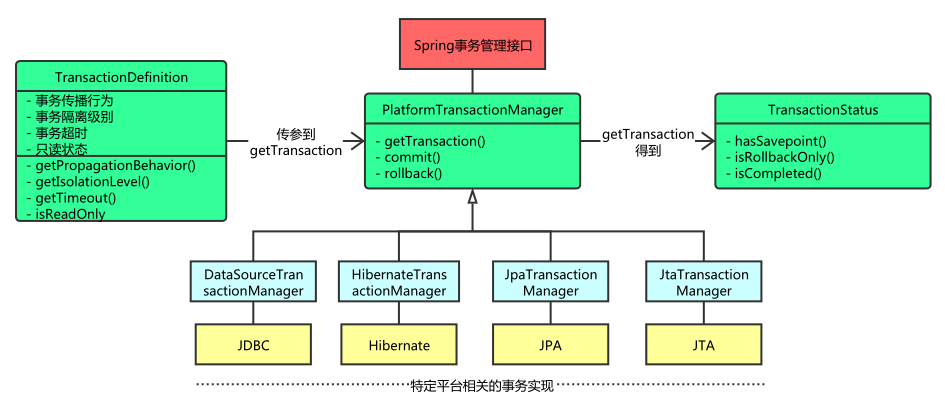
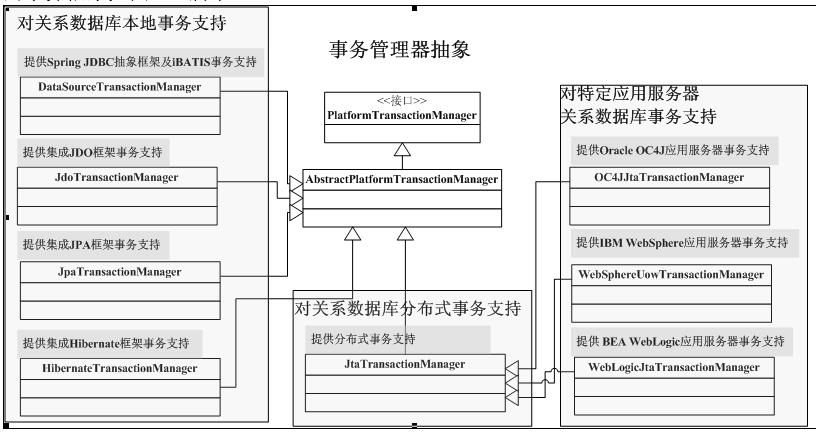
/** * This is the central interface in Spring's transaction infrastructure. * Applications can use this directly, but it is not primarily meant as API: * Typically, applications will work with either TransactionTemplate or * declarative transaction demarcation through AOP. */ public interface PlatformTransactionManager { TransactionStatus getTransaction(TransactionDefinition definition) throws TransactionException; void commit(TransactionStatus status) throws TransactionException; void rollback(TransactionStatus status) throws TransactionException; }
@Override public void init() { registerBeanDefinitionParser("advice", new TxAdviceBeanDefinitionParser()); registerBeanDefinitionParser("annotation-driven", new AnnotationDrivenBeanDefinitionParser()); registerBeanDefinitionParser("jta-transaction-manager", new JtaTransactionManagerBeanDefinitionParser()); }
主要是TransactionInterceptor类
1 2 3 4 5 6 7 8 9 10 11 12 13 14 15
public Object invoke(final MethodInvocation invocation) throws Throwable { // Work out the target class: may be {@code null}. // The TransactionAttributeSource should be passed the target class // as well as the method, which may be from an interface. Class<?> targetClass = (invocation.getThis() != null ? AopUtils.getTargetClass(invocation.getThis()) : null);
// Adapt to TransactionAspectSupport's invokeWithinTransaction... //主要逻辑在父类 return invokeWithinTransaction(invocation.getMethod(), targetClass, new InvocationCallback() { @Override public Object proceedWithInvocation() throws Throwable { return invocation.proceed(); } }); }
if (txAttr == null || !(tm instanceof CallbackPreferringPlatformTransactionManager)) { // Standard transaction demarcation with getTransaction and commit/rollback calls. // 判断创建Transaction TransactionInfo txInfo = createTransactionIfNecessary(tm, txAttr, joinpointIdentification); Object retVal = null; try { // This is an around advice: Invoke the next interceptor in the chain. // This will normally result in a target object being invoked. //执行业务逻辑 retVal = invocation.proceedWithInvocation(); } catch (Throwable ex) { // target invocation exception // 出现异常,回滚 completeTransactionAfterThrowing(txInfo, ex); throw ex; } finally { //清除当前事务状态 cleanupTransactionInfo(txInfo); } //提交事务 commitTransactionAfterReturning(txInfo); return retVal; }
public final TransactionStatus getTransaction(TransactionDefinition definition) throws TransactionException { //得到各个不同数据源的事务对象,spring尽然没有把transaction对象抽象出来,很是奇怪 Object transaction = doGetTransaction();
// Cache debug flag to avoid repeated checks. boolean debugEnabled = logger.isDebugEnabled();
if (definition == null) { // Use defaults if no transaction definition given. definition = new DefaultTransactionDefinition(); }
//此事务是否已经存在 if (isExistingTransaction(transaction)) { // Existing transaction found -> check propagation behavior to find out how to behave. return handleExistingTransaction(definition, transaction, debugEnabled); }
// Check definition settings for new transaction. if (definition.getTimeout() < TransactionDefinition.TIMEOUT_DEFAULT) { throw new InvalidTimeoutException("Invalid transaction timeout", definition.getTimeout()); }
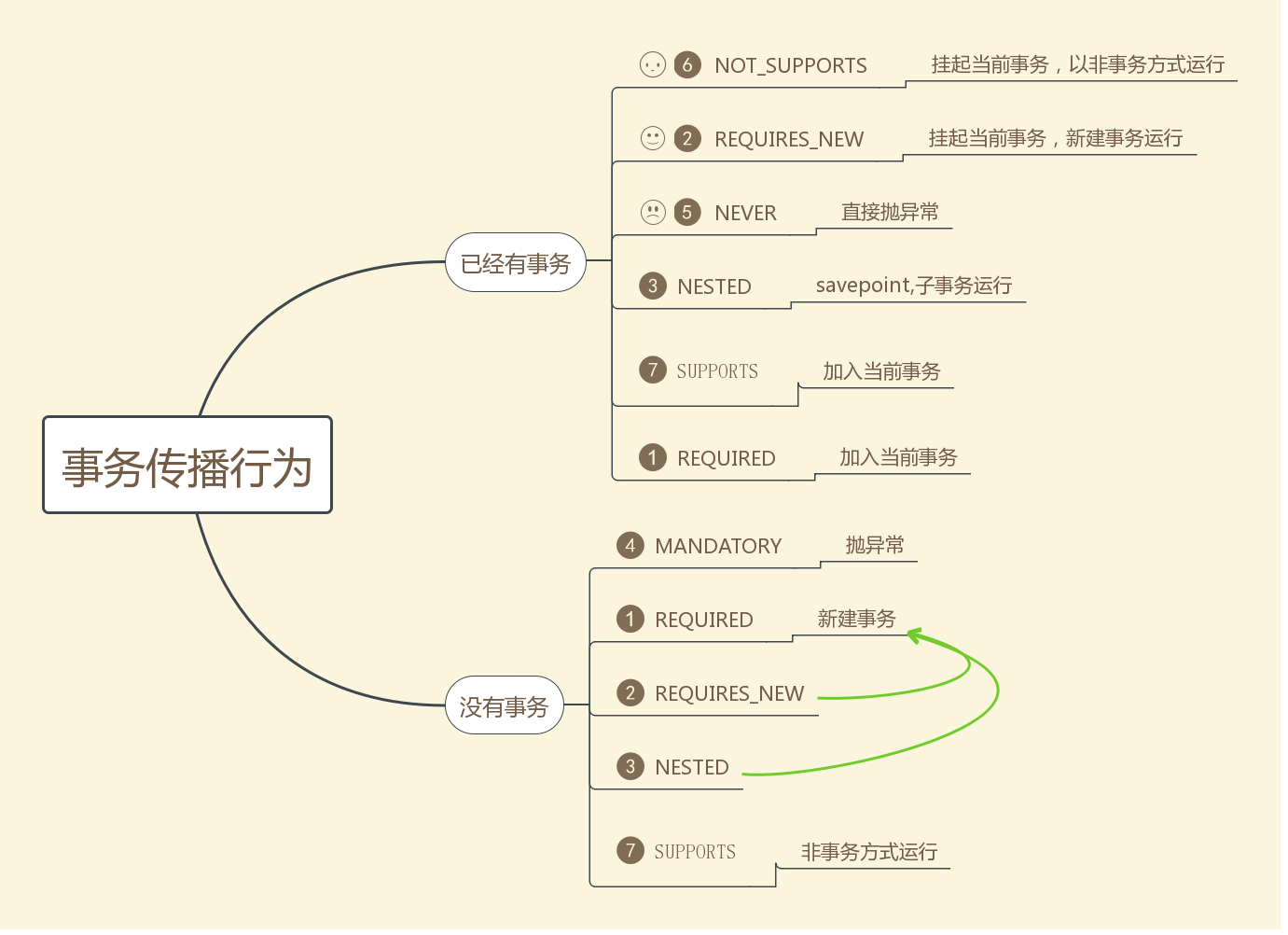
// No existing transaction found -> check propagation behavior to find out how to proceed. if (definition.getPropagationBehavior() == TransactionDefinition.PROPAGATION_MANDATORY) { throw new IllegalTransactionStateException( "No existing transaction found for transaction marked with propagation 'mandatory'"); } //这三种都是新建事务 else if (definition.getPropagationBehavior() == TransactionDefinition.PROPAGATION_REQUIRED || definition.getPropagationBehavior() == TransactionDefinition.PROPAGATION_REQUIRES_NEW || definition.getPropagationBehavior() == TransactionDefinition.PROPAGATION_NESTED) { SuspendedResourcesHolder suspendedResources = suspend(null); if (debugEnabled) { logger.debug("Creating new transaction with name [" + definition.getName() + "]: " + definition); } try { boolean newSynchronization = (getTransactionSynchronization() != SYNCHRONIZATION_NEVER); DefaultTransactionStatus status = newTransactionStatus( definition, transaction, true, newSynchronization, debugEnabled, suspendedResources); //开始获取链接,开启事务,绑定资源到当前线程 doBegin(transaction, definition); prepareSynchronization(status, definition); return status; } catch (RuntimeException | Error ex) { resume(null, suspendedResources); throw ex; } } else { // Create "empty" transaction: no actual transaction, but potentially synchronization. if (definition.getIsolationLevel() != TransactionDefinition.ISOLATION_DEFAULT && logger.isWarnEnabled()) { logger.warn("Custom isolation level specified but no actual transaction initiated; " + "isolation level will effectively be ignored: " + definition); } boolean newSynchronization = (getTransactionSynchronization() == SYNCHRONIZATION_ALWAYS); return prepareTransactionStatus(definition, null, true, newSynchronization, debugEnabled, null); } }
TransactionStatus
这儿返回的是TransactionStatus
1 2 3 4 5 6 7 8 9 10 11 12 13
public interface TransactionStatus extends SavepointManager, Flushable {
boolean isNewTransaction();
boolean hasSavepoint();
void setRollbackOnly();
boolean isRollbackOnly();
void flush();
boolean isCompleted();
TransactionInfo
事务信息
1 2 3 4 5 6 7 8 9 10 11 12 13
protected final class TransactionInfo {
private final PlatformTransactionManager transactionManager;
private final TransactionAttribute transactionAttribute;
// Raise UnexpectedRollbackException if we had a global rollback-only marker if (unexpectedRollback) { throw new UnexpectedRollbackException( "Transaction rolled back because it has been marked as rollback-only"); } } finally { cleanupAfterCompletion(status); }