该类提供了线程局部 (thread-local)变量。 这些变量不同于它们的普通对应物,因为访问某个变量(通过其 get 或 set 方法)的每个线程都有自己的局部变量,它独立于变量的初始化副本。 ThreadLocal 实例通常是类中的 private static 字段,它们希望将状态与某一个线程(例如,用户 ID 或事务 ID)相关联。
public class HibernateUtil {
    private static Log log = LogFactory.getLog(HibernateUtil.class);
    private static final SessionFactory sessionFactory;     //定义SessionFactory

    static {
        try {
            // 通过默认配置文件hibernate.cfg.xml创建SessionFactory
            sessionFactory = new Configuration().configure().buildSessionFactory();
        } catch (Throwable ex) {
            log.error("初始化SessionFactory失败!", ex);
            throw new ExceptionInInitializerError(ex);
        }
    }

    //创建线程局部变量session,用来保存Hibernate的Session
    public static final ThreadLocal session = new ThreadLocal();

    /**
     * 获取当前线程中的Session
     * @return Session
     * @throws HibernateException
     */
    public static Session currentSession() throws HibernateException {
        Session s = (Session) session.get();
        // 如果Session还没有打开,则新开一个Session
        if (s == null) {
            s = sessionFactory.openSession();
            session.set(s);         //将新开的Session保存到线程局部变量中
        }
        return s;
    }

    public static void closeSession() throws HibernateException {
        //获取线程局部变量,并强制转换为Session类型
        Session s = (Session) session.get();
        session.set(null);
        if (s != null)
            s.close();
    }
}
Threadlocal源码
这个类有以下方法:
get():返回当前线程拷贝的局部线程变量的值。
initialValue():返回当前线程赋予局部线程变量的初始值。
remove():移除当前线程赋予局部线程变量的值。
set(T value):为当前线程拷贝的局部线程变量设置一个特定的值。
get()方法
1
2
3
4
5
6
7
8
9
10
public T get() {
        Thread t = Thread.currentThread();
        ThreadLocalMap map = getMap(t);
        if (map != null) {
            ThreadLocalMap.Entry e = map.getEntry(this);
            if (e != null)
                return (T)e.value;
        }
        return setInitialValue();
    }
根据当前线程,拿到ThreadLocalMap,通过当前threadloal对象取到value.
1
2
3
4
5
6
7
8
9
10
11
12
13
14
15
16
17
18
private T setInitialValue() {
        T value = initialValue();
        Thread t = Thread.currentThread();
        ThreadLocalMap map = getMap(t);
        if (map != null)
            map.set(this, value);
        else
            createMap(t, value);
        return value;
}

ThreadLocalMap getMap(Thread t) {
        return t.threadLocals;
}

void createMap(Thread t, T firstValue) {
        t.threadLocals = new ThreadLocalMap(this, firstValue);
    }
Thread.java 里面
ThreadLocalMap是Thread的属性
1
2
3
/* ThreadLocal values pertaining to this thread. This map is maintained
     * by the ThreadLocal class. */
    ThreadLocal.ThreadLocalMap threadLocals = null;
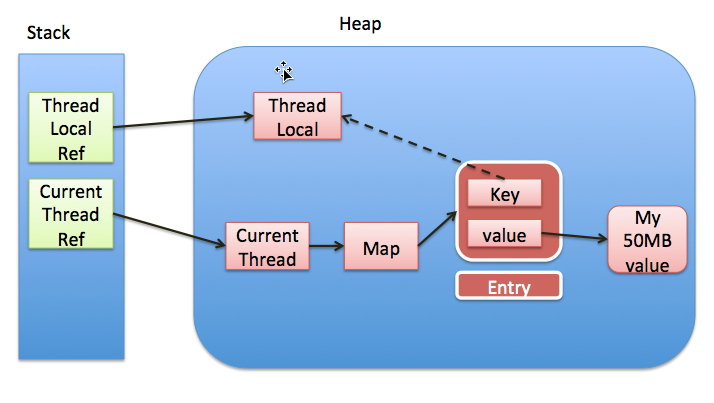
Thread Ref -> Thread -> ThreaLocalMap -> Entry -> value
永远无法回收,造成内存泄露。
进一步分析一下ThreadlocalMap
1
2
3
4
5
6
7
8
9
10
11
/**
     * ThreadLocalMap is a customized hash map suitable only for
     * maintaining thread local values. No operations are exported
     * outside of the ThreadLocal class. The class is package private to
     * allow declaration of fields in class Thread.  To help deal with
     * very large and long-lived usages, the hash table entries use
     * WeakReferences for keys. However, since reference queues are not
     * used, stale entries are guaranteed to be removed only when
     * the table starts running out of space.
     */
    static class ThreadLocalMap {
/** * The entries in this hash map extend WeakReference, using * its main ref field as the key (which is always a * ThreadLocal object). Note that null keys (i.e. entry.get() * == null) mean that the key is no longer referenced, so the * entry can be expunged from table. Such entries are referred to * as "stale entries" in the code that follows. */ static class Entry extends WeakReference<ThreadLocal> { /** The value associated with this ThreadLocal. */ Object value;
/** * Construct a new map initially containing (firstKey, firstValue). * ThreadLocalMaps are constructed lazily, so we only create * one when we have at least one entry to put in it. */ ThreadLocalMap(ThreadLocal firstKey, Object firstValue) { //默认16长度 table = new Entry[INITIAL_CAPACITY]; //hashcode取模,得到坑位 int i = firstKey.threadLocalHashCode & (INITIAL_CAPACITY - 1); table[i] = new Entry(firstKey, firstValue); size = 1; setThreshold(INITIAL_CAPACITY); }
/** * Set the resize threshold to maintain at worst a 2/3 load factor. */ private void setThreshold(int len) { threshold = len * 2 / 3; }
private void set(ThreadLocal key, Object value) {
// We don't use a fast path as with get() because it is at // least as common to use set() to create new entries as // it is to replace existing ones, in which case, a fast // path would fail more often than not. Entry[] tab = table; int len = tab.length; int i = key.threadLocalHashCode & (len - 1);
for (Entry e = tab[i]; e != null; e = tab[i = nextIndex(i, len)]) { ThreadLocal k = e.get();
tab[i] = new Entry(key, value); int sz = ++size; if (!cleanSomeSlots(i, sz) && sz >= threshold) rehash(); } private void replaceStaleEntry(ThreadLocal key, Object value, int staleSlot) { Entry[] tab = table; int len = tab.length; Entry e;
// Back up to check for prior stale entry in current run. // We clean out whole runs at a time to avoid continual // incremental rehashing due to garbage collector freeing // up refs in bunches (i.e., whenever the collector runs). int slotToExpunge = staleSlot; //替换掉之前有key=null的 for (int i = prevIndex(staleSlot, len); (e = tab[i]) != null; i = prevIndex(i, len)) if (e.get() == null) slotToExpunge = i;
// Find either the key or trailing null slot of run, whichever // occurs first for (int i = nextIndex(staleSlot, len); (e = tab[i]) != null; i = nextIndex(i, len)) { ThreadLocal k = e.get();
// If we find key, then we need to swap it // with the stale entry to maintain hash table order. // The newly stale slot, or any other stale slot // encountered above it, can then be sent to expungeStaleEntry // to remove or rehash all of the other entries in run. if (k == key) { e.value = value;
tab[i] = tab[staleSlot]; tab[staleSlot] = e;
// Start expunge at preceding stale entry if it exists if (slotToExpunge == staleSlot) slotToExpunge = i; cleanSomeSlots(expungeStaleEntry(slotToExpunge), len); return; }
// If we didn't find stale entry on backward scan, the // first stale entry seen while scanning for key is the // first still present in the run. if (k == null && slotToExpunge == staleSlot) slotToExpunge = i; }
// If key not found, put new entry in stale slot tab[staleSlot].value = null; tab[staleSlot] = new Entry(key, value);
// If there are any other stale entries in run, expunge them if (slotToExpunge != staleSlot) cleanSomeSlots(expungeStaleEntry(slotToExpunge), len); }