RPC 原理
什么是Stub?
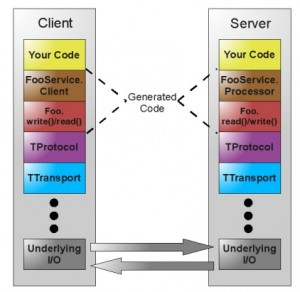
Stub是一段代码,用来转换RPC过程中传递的参数。处理内容包括不同OS之间的大小端问题。另外,Client端一般叫Stub,Server端一般叫Skeleton。
生产方式:
手动生成,比较麻烦;
自动生成,使用IDL(InterfaceDescriptionLanguate),定义C/S的接口
RPC的套路: 自古深情留不住 唯有套路留人心
RPC最本质的就是通过socket把方法信息传输到远程服务器并执行相应method
在java界的rpc框架的实现手法:
服务端:socket + 反射
客户端:动态代理 + socket
之前也解析过motain框架,《motain客服端分析》 、《motain服务端分析》
thrift 由于我司框架是通过thrift改造,发现这个框架没有按java套路出牌,可能这是跨语言类RPC的套路,有必要了解一下
thrift最初由facebook开发用做系统内各语言之间的RPC通信 。2007年由facebook贡献到apache基金 ,08年5月进入apache孵化器,支持多种语言之间的RPC方式的通信:php语言client可以构造一个对象,调用相应的服务方法来调用java语言的服务 ,跨越语言的C/S RPC调用
示例 IDL文件 1 2 3 4 5 //HelloService.thrfit namespace java com.jack.thrift service HelloService{ string helloString(1:string what) }
生成代码 1 2 运行 thrift -gen HelloService.thrfit
会生成一个HelloService类
实现服务端与客服端 让服务端打印出客户端传入的参数
服务端 1 2 3 4 5 6 7 8 9 10 11 12 13 14 15 16 17 18 19 20 21 22 23 public class ThriftServer { /** * 启动thrift服务器 * @param args */ public static void main(String[] args) throws Exception { try { System.out.println("服务端开启...."); TProcessor tprocessor = new HelloService.Processor<HelloService.Iface>(new HelloServiceImpl()); // 简单的单线程服务模型 TServerSocket serverTransport = new TServerSocket(9898); TServer.Args tArgs = new TServer.Args(serverTransport); tArgs.processor(tprocessor); tArgs.protocolFactory(new TBinaryProtocol.Factory()); TServer server = new TSimpleServer(tArgs); server.serve(); }catch (Exception e) { e.printStackTrace(); } } }
客户端 1 2 3 4 5 6 7 8 9 10 11 12 13 14 15 16 17 18 19 20 21 22 23 24 public class ThriftClient { public static void main(String[] args) { System.out.println("客户端启动...."); TTransport transport = null; try { transport = new TSocket("localhost", 9898, 30000); // 协议要和服务端一致 TProtocol protocol = new TBinaryProtocol(transport); HelloService.Client client = new HelloService.Client(protocol); transport.open(); String result = client.helloString("哈哈"); System.out.println(result); } catch (TTransportException e) { e.printStackTrace(); } catch (TException e) { e.printStackTrace(); } finally { if (null != transport) { transport.close(); } } } }
解析 可以看出server,client代码相对很简单,主要看看生成的HelloService类,这个类就是stub代码
来看一下,这个类是如何封装,把method和args传输到远程的
client 1 2 HelloService.Client client = new HelloService.Client(protocol); String result = client.helloString("哈哈");
关键点在HelloService.Client.helloString()方法
1 2 3 4 5 public String helloString(String what) throws org.apache.thrift.TException { send_helloString(what); return recv_helloString(); }
发送消息 1 2 3 4 5 6 public void send_helloString(String what) throws org.apache.thrift.TException { helloString_args args = new helloString_args(); args.setWhat(what); sendBase("helloString", args); }
把args抽象成了一个类
属性赋值
发送
主要看下sendBase()方法
1 2 3 4 5 6 private void sendBase(String methodName, TBase<?,?> args, byte type) throws TException { oprot_.writeMessageBegin(new TMessage(methodName, type, ++seqid_)); args.write(oprot_); oprot_.writeMessageEnd(); oprot_.getTransport().flush(); }
1.oprot_.writeMessageBegin 根据Protocol写数据,比如这儿使用的TBinaryProtocol,以二进制写数据
1 2 3 4 5 6 7 8 9 10 11 12 public void writeMessageBegin(TMessage message) throws TException { if (strictWrite_) { int version = VERSION_1 | message.type; writeI32(version); writeString(message.name); writeI32(message.seqid); } else { writeString(message.name); writeByte(message.type); writeI32(message.seqid); } }
再深入看看怎么写二进制数据的
int类型
1 2 3 4 5 6 7 public void writeI32(int i32) throws TException { inoutTemp[0] = (byte)(0xff & (i32 >> 24)); inoutTemp[1] = (byte)(0xff & (i32 >> 16)); inoutTemp[2] = (byte)(0xff & (i32 >> 8)); inoutTemp[3] = (byte)(0xff & (i32)); trans_.write(inoutTemp, 0, 4); }
string类型,先写长度,再写bytes
1 2 3 4 5 6 7 8 9 public void writeString(String str) throws TException { try { byte[] dat = str.getBytes("UTF-8"); writeI32(dat.length); trans_.write(dat, 0, dat.length); } catch (UnsupportedEncodingException uex) { throw new TException("JVM DOES NOT SUPPORT UTF-8"); } }
这儿写最终还是使用Transport.write,比如这儿使用的TSocket
1 2 3 4 5 6 7 8 9 10 public void write(byte[] buf, int off, int len) throws TTransportException { if (outputStream_ == null) { throw new TTransportException(TTransportException.NOT_OPEN, "Cannot write to null outputStream"); } try { outputStream_.write(buf, off, len); } catch (IOException iox) { throw new TTransportException(TTransportException.UNKNOWN, iox); } }
就是写到
1 outputStream_ = new BufferedOutputStream(socket_.getOutputStream(), 1024);
1 2 3 4 5 6 7 8 9 10 11 12 public void write(org.apache.thrift.protocol.TProtocol oprot, helloString_args struct) throws org.apache.thrift.TException { struct.validate(); oprot.writeStructBegin(STRUCT_DESC); if (struct.what != null) { oprot.writeFieldBegin(WHAT_FIELD_DESC); oprot.writeString(struct.what); oprot.writeFieldEnd(); } oprot.writeFieldStop(); oprot.writeStructEnd(); }
这就是写field,也就是向输出流里写参数内容
1 2 3 4 5 6 7 8 9 10 11 12 13 /** * Flushes the underlying output stream if not null. */ public void flush() throws TTransportException { if (outputStream_ == null) { throw new TTransportException(TTransportException.NOT_OPEN, "Cannot flush null outputStream"); } try { outputStream_.flush(); } catch (IOException iox) { throw new TTransportException(TTransportException.UNKNOWN, iox); } }
client总结 整个发送消息就结束了,虽然没有按套路使用动态代理,而是通过生成的stub代码,把methodName,args给封装好了
server 服务端也没有通过反射的方式
主要逻辑在生成的HelloService$Processor类中
1 2 3 4 5 6 7 8 9 10 11 12 13 14 15 16 17 18 19 20 21 22 23 24 25 26 27 28 29 30 31 32 33 34 35 36 37 38 39 40 41 public static class Processor<I extends Iface> extends org.apache.thrift.TBaseProcessor<I> implements org.apache.thrift.TProcessor { private static final org.slf4j.Logger _LOGGER = org.slf4j.LoggerFactory.getLogger(Processor.class.getName()); public Processor(I iface) { super(iface, getProcessMap(new java.util.HashMap<String, org.apache.thrift.ProcessFunction<I, ? extends org.apache.thrift.TBase>>())); } protected Processor(I iface, java.util.Map<String, org.apache.thrift.ProcessFunction<I, ? extends org.apache.thrift.TBase>> processMap) { super(iface, getProcessMap(processMap)); } private static <I extends Iface> java.util.Map<String, org.apache.thrift.ProcessFunction<I, ? extends org.apache.thrift.TBase>> getProcessMap(java.util.Map<String, org.apache.thrift.ProcessFunction<I, ? extends org.apache.thrift.TBase>> processMap) { processMap.put("helloString", new helloString()); return processMap; } public static class helloString<I extends Iface> extends org.apache.thrift.ProcessFunction<I, helloString_args> { public helloString() { super("helloString"); } public helloString_args getEmptyArgsInstance() { return new helloString_args(); } protected boolean isOneway() { return false; } @Override protected boolean handleRuntimeExceptions() { return false; } public helloString_result getResult(I iface, helloString_args args) throws org.apache.thrift.TException { helloString_result result = new helloString_result(); result.success = iface.helloString(args.what); return result; } } }
1 2 3 4 5 6 7 8 protected Processor(I iface, java.util.Map<String, org.apache.thrift.ProcessFunction<I, ? extends org.apache.thrift.TBase>> processMap) { super(iface, getProcessMap(processMap)); } private static <I extends Iface> java.util.Map<String, org.apache.thrift.ProcessFunction<I, ? extends org.apache.thrift.TBase>> getProcessMap(java.util.Map<String, org.apache.thrift.ProcessFunction<I, ? extends org.apache.thrift.TBase>> processMap) { processMap.put("helloString", new helloString()); return processMap; }
这段把methodName与对应的处理类映射,那后面的事就简单了,当接受到消息,取得methodName,通过map获取对就的处理类回调就可以
1
2
3
4
5
6
7
8
9
10
11
12
13
14
15
16
17
18
19
20
21
22
23
24
public static class helloString<I extends Iface> extends org.apache.thrift.ProcessFunction<I, helloString_args> { public helloString() { super("helloString"); } public helloString_args getEmptyArgsInstance() { return new helloString_args(); } protected boolean isOneway() { return false; } @Override protected boolean handleRuntimeExceptions() { return false; } public helloString_result getResult(I iface, helloString_args args) throws org.apache.thrift.TException { helloString_result result = new helloString_result(); result.success = iface.helloString(args.what); return result; } }
处理类,继承ProcessFunction类,实现getResult(),这个方法就是调用了对应service.helloString()
可以再深入看一下,在socket监听消息时
1 2 3 4 5 6 7 8 9 10 11 12 13 14 15 16 17 18 client = serverTransport_.accept(); if (client != null) { processor = processorFactory_.getProcessor(client); inputTransport = inputTransportFactory_.getTransport(client); outputTransport = outputTransportFactory_.getTransport(client); inputProtocol = inputProtocolFactory_.getProtocol(inputTransport); outputProtocol = outputProtocolFactory_.getProtocol(outputTransport); if (eventHandler_ != null) { connectionContext = eventHandler_.createContext(inputProtocol, outputProtocol); } while (true) { if (eventHandler_ != null) { eventHandler_.processContext(connectionContext, inputTransport, outputTransport); } if(!processor.process(inputProtocol, outputProtocol)) { break; } }
关键行:processor.process(inputProtocol, outputProtocol)
1 2 3 4 5 6 7 8 9 10 11 12 13 14 15 16 public boolean process(TProtocol in, TProtocol out) throws TException { TMessage msg = in.readMessageBegin(); ProcessFunction fn = processMap.get(msg.name); if (fn == null) { TProtocolUtil.skip(in, TType.STRUCT); in.readMessageEnd(); TApplicationException x = new TApplicationException(TApplicationException.UNKNOWN_METHOD, "Invalid method name: '"+msg.name+"'"); out.writeMessageBegin(new TMessage(msg.name, TMessageType.EXCEPTION, msg.seqid)); x.write(out); out.writeMessageEnd(); out.getTransport().flush(); return true; } fn.process(msg.seqid, in, out, iface); return true; }
这就很明显了,通过methodName从map中取得ProccessFunction,再执行process方法,调用相应service的方法
总结 虽然thrift没有按以往java套路出牌,但最根本的把method发送到远程执行是一致的。可能对于多语言来讲,便于所以语言一致性,的确需要通过生成的stub代码手法来实现RPC
当然thrift并不简单,还有很多的内容需要深挖学习,但至少这个简单示例可以了解跨语言型的RPC,相关IDL,Stub的知识,有清晰认知,而不局限于概念